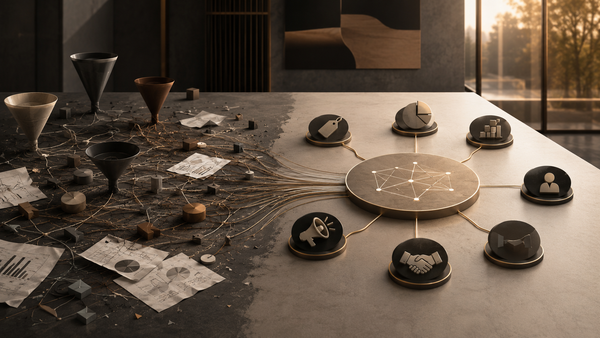
From Delivery to Proof


The Rise of Process Over Faith
The modern corporate world has become obsessed with cadence, process, dashboards, playbooks, and repeatability. There is a cold reason for that obsession. The more information exists, the less room remains for faith.
When everything can be measured, a result stops feeling like a miracle and starts looking like an entry in a table. And every entry in a table invites the same question: was it competence, or was it luck?
If a company cannot explain why something worked, it usually defaults to the instinct it trusts most: control.
That is where one of the unwritten rules of the modern market begins. It is no longer enough to deliver. You need to be auditable.
Not because anyone is curious.
Because businesses are trying to protect themselves.
A result that cannot be repeated becomes risk. A result that cannot be taught becomes dependency. You stop being seen only as valuable and start being seen as fragile infrastructure.
If the machine only works because one person knows how to make it move, then the machine does not really work. It is simply surviving.
The Pressure for Method
This pressure for method did not appear out of nowhere. Gartner reported that sales organizations had gone through an average of four transformations over the prior two years, while only 11 percent managed to sustain commercial success while transforming (Gartner, 2023).
In the same research stream, 70 percent of sellers said they felt overwhelmed by the number of technologies required in their role, and 72 percent said they felt overwhelmed by the number of skills expected of them.
So yes, I have seen raw talent lose ground to people who were less gifted, but more structured.
Not because the world became unfair.
Because the world became anxious.
The Buyer Changed
And underneath that anxiety, another truth has quietly reshaped the profession.
The buyer changed.
You are no longer the owner of the information.
The buyer now arrives informed, skeptical, and often halfway through their own internal process. HubSpot reports that 96 percent of prospects research companies and products before engaging with a sales representative, and 71 percent prefer independent research over talking to a rep (HubSpot, 2024).
That changes the role of the seller.
Selling becomes less about presenting and more about guiding judgment.
Less about owning knowledge and more about organizing it.
Less about speaking first and more about becoming useful at the exact moment where information alone stops being enough.
Even that is not the whole story. Gartner found that 61 percent of B2B buyers prefer an overall rep-free buying experience, while 73 percent actively avoid suppliers who send irrelevant outreach (Gartner, 2024).
That is a brutal shift.
You are not only competing with other vendors anymore.
You are competing with the buyer's comfortable silence.
You are competing with a world in which the buyer can learn, compare, simulate, shortlist, and even begin building internal conviction without talking to anyone.
That is why process gained status.
Process became the language of trust.
The Irony of Standardization
But there is an irony here that still stings.
The same market that once romanticized autonomy, creativity, and individual style now wants everyone to move through the game with a documented path, a checklist, and a framework.
We grew up in a professional culture that celebrated personality and then woke up in one that prizes predictability above almost everything else.
And this is where it gets uncomfortable.
If you are truly exceptional, if you consistently perform at a level that makes people stop and notice, that does not always produce admiration first.
Sometimes it produces suspicion.
How does this person do it?
Is it sustainable?
Can anyone else do it?
If they leave, does the machine break?
That old reaction of pure amazement still exists. It just wears more polished clothes now. It shows up as "document the process," "build a playbook," "give me predictability," or "show me what worked."
Because the new trophy is not just the number.
It is the map.
The Human Element Never Left
And yet, even after all of this, the essence of selling has not changed.
Selling is still deeply human.
It lives in the rhythm of a conversation. In the timing of a silence. In the ability to read fear without naming it too early. In the sentence you choose not to say. In the moment you place price after the right emotional sequence, not before it. In the follow-up that lands when someone is finally open to a yes. In the way rapport is created without becoming performance.
That is not script.
That is sensitivity.
That is talent.
The problem is that sensitivity, when left untranslated, looks like mysticism.
And companies do not buy mysticism.
They buy method.
That is why the defining question of modern sales is no longer, "Do you deliver?"
It is, "Can you explain why you deliver?"
Complexity and Suspicion
That matters even more because the sales environment itself is more complex than it used to be. HubSpot reports that, on average, five decision makers are involved in every sale, and that 28 percent of sales professionals say lengthy sales processes are the primary reason prospects back out of deals (HubSpot, 2024).
Five people to convince.
Five different fears.
Five different standards.
Five different internal pressures.
And all of it happening against a clock that never stops moving.
In that kind of environment, even speed can start to look suspicious. Sometimes closing quickly makes people wonder whether something important was skipped, whether the ritual was followed, whether the result should really count.
That is where a lot of talented people get lost.
They know how to do the work.
They just do not know how to make the work legible.
The Balance
And that is why I believe in balance.
I do not believe in a world where process swallows talent.
I also do not believe in a world where talent gets to ignore process.
I believe in the professional who can deliver and show the path.
The one who can turn instinct into language.
The one who can transform private intelligence into something transferable.
Because that is the moment where talent stops looking like luck and starts looking like engineering.
To me, the ideal manager is not the one who suffocates everything with methodology. Nor is it the one who worships stars and mistakes that for leadership.
It is the one who wants to understand.
Why did that email close with one touch while others needed ten?
Why did that client respond on a Friday and not on a Monday?
Why did that argument unlock the objection so cleanly?
Because if there is something more valuable than selling, it is teaching someone else how to sell.
And maybe that is the hardest and most liberating truth in the market right now.
All the talent in the world becomes limited if you do not know how to make it visible.
Visible not as ego.
Visible as system.
Results are still king.
But in a world ruled by data, the kingdom asks for proof.
And when you learn how to provide that proof, something rare happens.
You stop being just a top performer.
You become a source of predictability.
And in the modern market, that is one of the closest things trust has left.